AI Verification
R2026bUse AI verification techniques to identify and mitigate risks by checking AI models and AI-driven systems for adherence to industry standards and regulations. The AI Verification Library for Deep Learning Toolbox provides tools for assessing and verifying properties of deep neural networks. For example, you can verify the robustness properties of a network, compute network output bounds, find adversarial examples, detect out-of-distribution data, and check for compliance with industry standards. Additionally the Deep Learning Toolbox Interface for alpha-beta-CROWN Verifier support package enables formal verification of PyTorch® and ONNX™ networks such as proving robustness properties.
If you have Statistics and Machine Learning Toolbox™, you can also verify the robustness of tree-based classifiers.
Functions
Topics
Algorithms
- Verification of Neural Networks
Learn about verification of neural networks using AI Verification Library for Deep Learning Toolbox™. - Verify Robustness of Deep Learning Neural Network
This example shows how to verify the adversarial robustness of a deep learning neural network. - Verify Robustness of Imported ONNX Network
This example shows how to verify the adversarial robustness of an imported ONNX™ deep neural network. (Since R2024a) - Out-of-Distribution Detection for Deep Neural Networks
This example shows how to detect out-of-distribution (OOD) data in deep neural networks. - Train Robust Deep Learning Network with Jacobian Regularization
Train a neural network that is robust to adversarial examples using a Jacobian regularization scheme. - Reproduce Network Training on a GPU
This example shows how to train a network several times on a GPU and get identical results. (Since R2024b) - Uncertainty Estimation for Regression (Statistics and Machine Learning Toolbox)
Learn about estimating the uncertainty of the true response for a regression problem. - Train Custom Quantile Neural Network
This example shows how to customize and train a neural network that makes quantile predictions. (Since R2026a) - Quantify Uncertainty in Object Detection Using Split Conformal Prediction
This example shows how to apply split conformal prediction (SCP) to an object detection model to quantify uncertainty in the predicted labels and bounding boxes. (Since R2026a) - Deep Learning Layers Supported for Formal Verification
Discover all the deep learning layers supported for AI verification. - AI Verification Tips and Tricks
Learn tips for formally verifying neural networks.
Time Series
- Battery State of Charge Estimation Using Deep Learning
Define requirements, prepare data, train deep learning networks, verify robustness, integrate networks into Simulink, and deploy models. (Since R2024b)
- STEP 1: Define Requirements for Battery State of Charge Estimation
- STEP 2: Prepare Data for Battery State of Charge Estimation Using Deep Learning
- STEP 3: Train Deep Learning Network for Battery State of Charge Estimation
- STEP 4: Compress Deep Learning Network for Battery State of Charge Estimation
- STEP 5: Test and Verify Deep Learning Network for Battery State of Charge Estimation
- STEP 6: Integrate AI Model into Simulink for Battery State of Charge Estimation
- STEP 7: Generate Code for Battery State of Charge Estimation Using Deep Learning
- STEP 8: Deploy Code for Battery State of Charge Estimation Using Deep Learning
- ECG Signal Classification Using Deep Learning
This example shows how to develop and verify a deep learning model that classifies electrocardiogram (ECG) signals to detect atrial fibrillation (AFib). (Since R2026a)
- STEP 1: Define Requirements for ECG Signal Classification Using Deep Learning
- STEP 2: Prepare Data for ECG Signal Classification
- STEP 3: Train Deep Learning Network for ECG Signal Classification
- STEP 4: Improve Adversarial Robustness of Deep Learning Network for ECG Signal Classification
- STEP 5: Test Deep Learning Network for ECG Signal Classification
- STEP 6: Out-of-Distribution Detection for ECG Signal Classification
- STEP 7: Uncertainty Quantification for ECG Signal Classification
- STEP 8: Investigate ECG Signal Classifications Using Grad-CAM
- STEP 9: Build Deep Learning ECG Signal Classification App Using App Designer
Tabular Data
- Verify and Deploy Airborne Collision Avoidance System (ACAS) Xu Neural Networks
Verify a set of neural networks trained for airborne collision avoidance integrated into a Simulink model using formal methods and scenario-based closed-loop testing. (Since R2026a)
- STEP 1: Explore ACAS Xu Neural Networks
- STEP 2: Verify Local Robustness of ACAS Xu Neural Networks
- STEP 3: Verify Global Stability of ACAS Xu Neural Networks
- STEP 4: Verify Global Stability of ACAS Xu Neural Network Using Adaptive Mesh
- STEP 5: Verify VNN-COMP Benchmark for ACAS Xu Neural Networks
- STEP 6: Verify VNN-COMP Benchmark for ACAS Xu Neural Networks Using α,β-CROWN
- STEP 7: Define and Verify AI Constituent Requirements for ACAS Xu Neural Networks
- STEP 8: Integrate ACAS Xu Neural Networks into Simulink
- STEP 9: Define and Verify AI System Requirements for ACAS Xu Neural Networks Integrated Into Simulink
- Transmission System Fault Detection Using Tree-Based Machine Learning Models
Define requirements, prepare data, train tree-based classifiers, verify predictive behavior, integrate classifiers into Simulink, and deploy models. (Since R2026b)
- STEP 1: Define Requirements for Transmission System Fault Detection
- STEP 2: Generate Data and Segment Signals for Transmission System Fault Detection
- STEP 3: Extract Features and Partition Data for Transmission System Fault Detection
- STEP 4: Perform Feature Selection and Model Training for Transmission System Fault Detection
- STEP 5: Assess Stability of Models for Transmission System Fault Detection
- STEP 6: Import and Verify Models in Simulink for Transmission System Fault Detection
- STEP 7: Generate C Code for Inference Models Used in Transmission System Fault Detection
Vision
- Generate Untargeted and Targeted Adversarial Examples for Image Classification
This example shows how to use the fast gradient sign method (FGSM) and the basic iterative method (BIM) to generate adversarial examples for a pretrained neural network. - Train Image Classification Network Robust to Adversarial Examples
This example shows how to train a neural network that is robust to adversarial examples using fast gradient sign method (FGSM) adversarial training. - Generate Adversarial Examples for Semantic Segmentation
This example shows how to generate adversarial examples for a semantic segmentation network using the basic iterative method (BIM). - Out-of-Distribution Data Discriminator for YOLO v4 Object Detector
This example shows how to detect out-of-distribution (OOD) data in a YOLO v4 object detector. - Verify an Airborne Deep Learning System
This example shows how to verify a deep learning system for airborne applications and is based on the work in [5,6,7], which includes the development and verification activities required by DO-178C [1], ARP4754A [2], and prospective EASA and FAA guidelines [3,4]. (Since R2023b)
Text
- Out-of-Distribution Detection for BERT Document Classifier
This example shows how to detect out-of-distribution data for a BERT document classifier. (Since R2024b) - Out-of-Distribution Detection for LSTM Document Classifier
This example shows how to detect out-of-distribution (OOD) data in an LSTM document classifier. (Since R2024a)
Certification Workflows
- Runway Sign Classifier: Certify an Airborne Deep Learning System (DO Qualification Kit)
Demonstrates the certification of airborne deep learning system.
Featured Examples
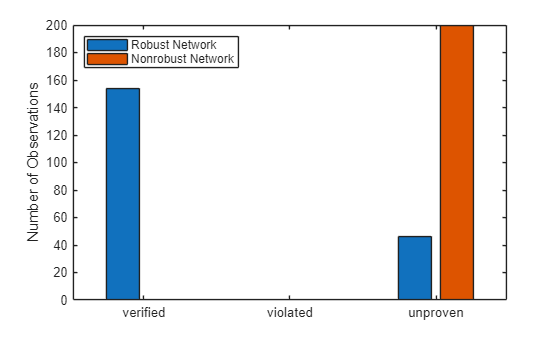
Verify Robustness of Deep Learning Neural Network
Verify the adversarial robustness of a deep learning neural network.
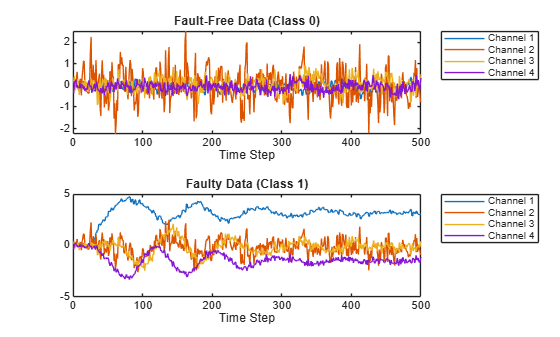
Out-of-Distribution Detection for Deep Neural Networks
Detect out-of-distribution (OOD) data in deep neural networks.
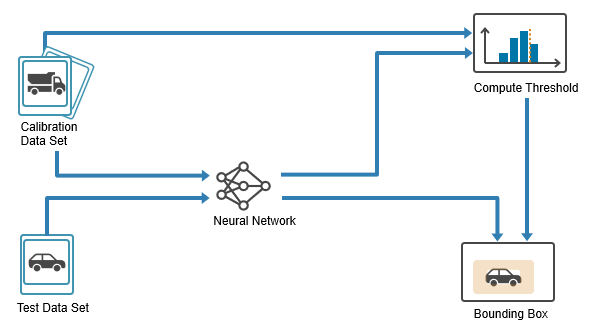
Quantify Uncertainty in Object Detection Using Split Conformal Prediction
Apply split conformal prediction (SCP) to an object detection model to quantify uncertainty in the predicted labels and bounding boxes.
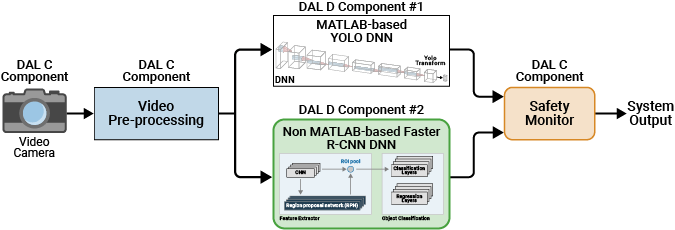
Verify an Airborne Deep Learning System
Verify a deep learning system for airborne applications and is based on the work in [5,6,7], which includes the development and verification activities required by DO-178C [1], ARP4754A [2], and prospective EASA and FAA guidelines [3,4]. To verify that the system complies with aviation industry standards and prospective guidelines, including activities such as requirements tracing, testing and reporting, see Runway Sign Classifier: Certify an Airborne Deep Learning System.
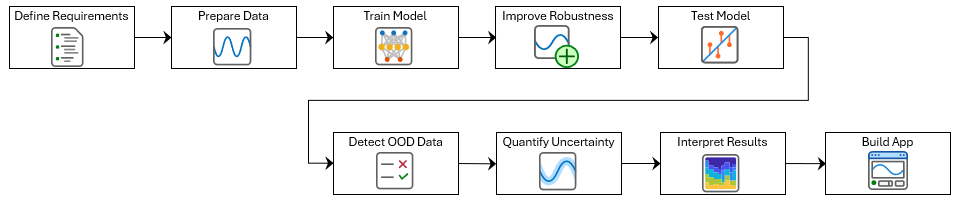
ECG Signal Classification Using Deep Learning
Develop and verify a deep learning model that classifies electrocardiogram (ECG) signals to detect atrial fibrillation (AFib). The example guides you through a complete workflow for building an AI system, with a focus on robustness, explainability, and verification against defined requirements.
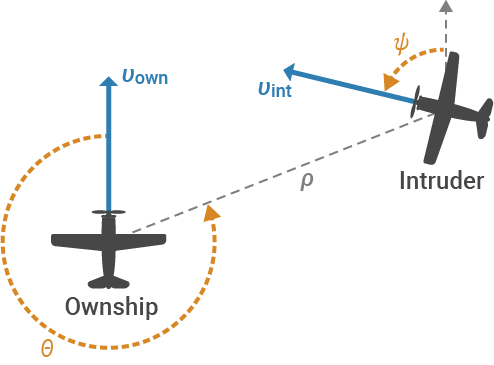
Verify and Deploy Airborne Collision Avoidance System (ACAS) Xu Neural Networks
Verify a set of neural networks trained for airborne collision avoidance integrated into a Simulink model using formal methods and scenario-based closed-loop testing.
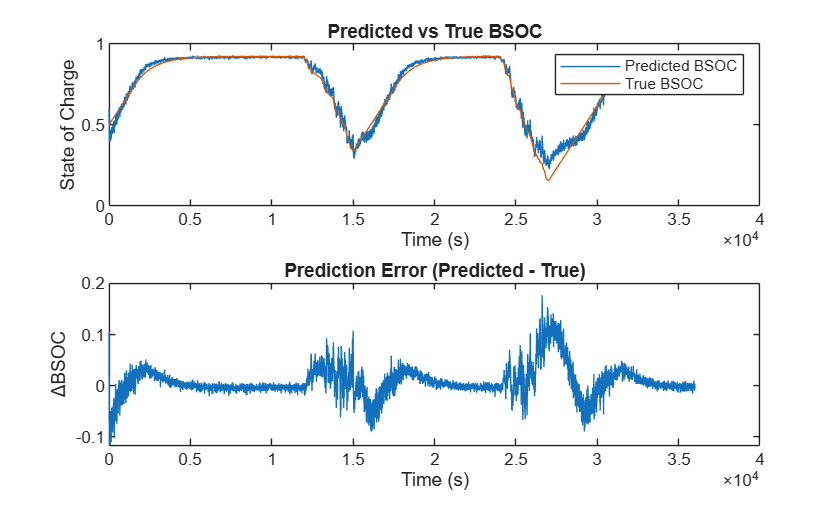
Generate AUTOSAR C Code for Deep Learning Model
Integrate a trained deep neural network in a Simulink® model mapped to an AUTOSAR Classic software component.

