Main Content

Valve Section with End Cap at F (IL-PB)

R2026b

Valve section with end cap at port F for hydromechanical valves

Since R2026b

  • Block icon

Libraries:
Simscape / Fluids / Isothermal Liquid / Valves & Orifices / Hydromechanical Valves

Description

The Valve Section with End Cap at F (IL-PB) block represents a valve segment that terminates in an end cap on side F. To model this component with the end cap on the opposite side, see Valve Section with End Cap at B (IL-PB).

Port Relations

Port B is a hydromechanical valve composite port that has valve_body, spool, and fluid nodes, where:

  • The distance between the end cap and B.valve_body is equal to the value of the Valve body section length parameter.

  • The distance between the end cap and B.spool is the gap length. When the gap length is 0, a hard stop engages.

  • The distance between port Fs and B.spool is equal to the value of the Shaft length parameter.

  • When you clear Valve section contains liquid, the valve section does not contain liquid and does not use the node B.fluid.

  • When you select Valve section contains liquid, the block models liquid flow inside the valve section and:

    • The liquid volume is V=A∗L, where L is the gap length and A is the value of the Liquid cross-sectional area in valve section parameter.

    • You can enable the isothermal liquid port Af, which models a branching flow path, by selecting Enable port Af for the liquid in the valve section.

Block Sub-Components

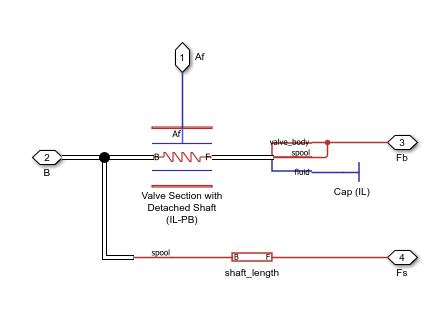
The Valve Section with End Cap at F (IL-PB) block is equivalent to a composite component comprised of these Simscape Foundation and Fluids library blocks:

The equivalent diagram is
system screenshot

Variables

To set the priority and initial target values for the block variables prior to simulation, use the Initial Targets section in the block dialog box or Property Inspector. For more information, see Set Priority and Initial Target for Block Variables.

Nominal values provide a way to specify the expected magnitude of a variable in a model. Using system scaling based on nominal values increases the simulation robustness. Nominal values can come from different sources, one of which is the Nominal Values section in the block dialog box or Property Inspector. For more information, see Modify Nominal Values for a Block Variable.

Examples
Ports

Conserving

expand all

Hydromechanical valve composite port that comprises three nodes:

  • B.valve_body — Position-based translational node along the valve body.

  • B.spool — Position-based translational node that moves along the spool.

  • B.fluid — Isothermal liquid node associated with the flow path inside the valve. If you select Valve section contains liquid, this node represents flow to and from an adjacent valve component. Otherwise, this node is unused.

Programmatic Use

Port: B

Isothermal liquid conserving port that represents a branching flow path for the fluid.

Dependencies

To enable this port, select Valve section contains liquid and Enable port Af for the liquid in valve section.

Programmatic Use

Port: Af

Position-based translational conserving port associated with the end of an additional shaft that extends beyond the end cap.

Dependencies

To enable this port, select Enable port Fs for spool at shaft end.

Programmatic Use

Port: Fs

Position-based translational conserving port associated with the end cap.

Dependencies

To enable this port, select Enable port Fb for valve body at end cap.

Programmatic Use

Port: Fb

Parameters

expand all

Valve Section

Length of the body section of the valve.

Programmatic Use

Parameter: body_length

Length of the valve shaft. The shaft can extend beyond the end cap.

Programmatic Use

Parameter: shaft_length

Whether the valve section contains liquid.

Programmatic Use

Parameter: contains_liquid
Values: "true" | "false"

Cross-sectional area of the liquid in the valve.

Dependencies

To enable this parameter, select Valve section contains liquid.

Programmatic Use

Parameter: section_area

Liquid volume when the node B.spool is against the end cap.

Dependencies

To enable this parameter, select Valve section contains liquid.

Programmatic Use

Parameter: dead_volume

Option to enable the isothermal liquid port Af, which represents a branching flow path for the fluid.

Dependencies

To enable this parameter, select Valve section contains liquid.

Programmatic Use

Parameter: enable_liquid_port
Values: "true" | "false"

Option to model port Fs, which represents the end of an additional shaft.

Programmatic Use

Parameter: enable_shaft_port
Values: "true" | "false"

Option to model port Fb, which represents the end cap.

Programmatic Use

Parameter: enable_cap_port
Values: "true" | "false"

Whether to model the dynamic compressibility of the liquid. Dynamic compressibility affects the transient response of the system at small timescales. If you select this parameter, the pressure responds dynamically based on the accumulation of fluid mass in the volume. If you clear this parameter, the volume does not accumulate mass and the pressure response is instantaneous. Clearing this setting can improve simulation performance, but may have a negative effect on the simulation robustness. Only clear this setting for small fluid volumes or models with long simulation times.

Dependencies

To enable this parameter, select Valve section contains liquid.

Programmatic Use

Parameter: enable_dynamic_compressibility
Values: "true" | "false"

Pressure for the isothermal liquid at the start of the simulation.

Dependencies

To enable this parameter, select Valve section contains liquid and Enable fluid dynamic compressibility.

Programmatic Use

Parameter: p_init

Liquid pressure in the valve at nominal operating conditions.

Dependencies

To enable this parameter, select Valve section contains liquid and clear Enable fluid dynamic compressibility.

Programmatic Use

Parameter: p_nominal

Spring

Option to model a spring between the spool and the end cap.

Programmatic Use

Parameter: enable_spring
Values: "true" | "false"

Spring rate.

Dependencies

To enable this parameter, select Enable spring between spool at B and end cap.

Programmatic Use

Parameter: spring_stiffness

Spring force when the gap between the spool position at port B and the end cap is the value of the Reference gap length between spool at B and end cap parameter.

Dependencies

To enable this parameter, select Enable spring between spool at B and end cap.

Programmatic Use

Parameter: spring_force_ref

Length between the spool position at port B and the end cap that corresponds to the Spring force at reference gap length parameter.

Dependencies

To enable this parameter, select Enable spring between spool at B and end cap.

Programmatic Use

Parameter: gap_length_ref

Hard Stop

Method to use to model the hard stop:

  • Stiffness and damping applied smoothly through transition region, damped rebound — Specify the transition region in which the force ramps up from zero. At the end of the transition region, the block applies the full stiffness and damping. This option applies damping on the rebound, but limits it to the value of the stiffness force. Therefore, damping can reduce or eliminate the force provided by the stiffness, but never exceed it. All equations are smooth and produce no zero crossings.

  • Full stiffness and damping applied at bounds, undamped rebound — This option applies full stiffness and damping with impact, and applies no damping on the rebound. The equations produce no zero crossings when velocity changes sign, but there are position-based zero crossings. This option uses nonlinear equations.

  • Full stiffness and damping applied at bounds, damped rebound — This model has full stiffness and damping applied with impact, with damping applied on the rebound as well. The equations are switched linear, but produce position-based zero crossings. Use this option if the simscape.findNonlinearBlocks function indicates that this block prevents the network from being switched linear.

Programmatic Use

Parameter: hardstop_model
Values: "foundation.enum.HardStopStiffness.Smooth" | "foundation.enum.HardStopStiffness.FullUndamped" | "foundation.enum.HardStopStiffness.FullDamped"

Elastic property of the colliding bodies. The greater the value of this parameter, the less the bodies penetrate into each other and the more rigid the impact becomes. Setting this parameter to lesser values makes contact softer, but improves convergence and computational efficiency.

Programmatic Use

Parameter: hardstop_stiffness

Dissipating property of the colliding bodies. The greater the value of this parameter, the more energy dissipates during impact.

Programmatic Use

Parameter: hardstop_damping

Region where the force ramps up from zero to the full value. At the end of the transition region, the block applies full stiffness and damping.

Dependencies

To enable this parameter, set Hard stop model between spool at B and end cap to Stiffness and damping applied smoothly through transition region, damped rebound.

Programmatic Use

Parameter: hardstop_transition

Extended Capabilities

expand all

C/C++ Code Generation
Generate C and C++ code using Simulink® Coder™.

Version History

Introduced in R2026b