Main Content

height2range

Convert target height to propagated range

Since R2021b

Description

r = height2range(tgtht,anht,el) returns the propagated range to the target, r, as a function of the target height tgtht, the sensor height anht, and the elevation angle of the sensor el, assuming a Curved Earth Model with a 4/3 effective Earth radius factor. r is the distance along the slightly curved propagated path that results from atmospheric refraction and is longer than the straight-line geometric distance between the sensor and target.

example

r = height2range(tgtht,anht,el,Name=Value) specifies additional inputs using name-value arguments. For example, you can specify a flat Earth model, a curved Earth model with a given radius, or a CRPL Exponential Reference Atmosphere Model with custom values.

example

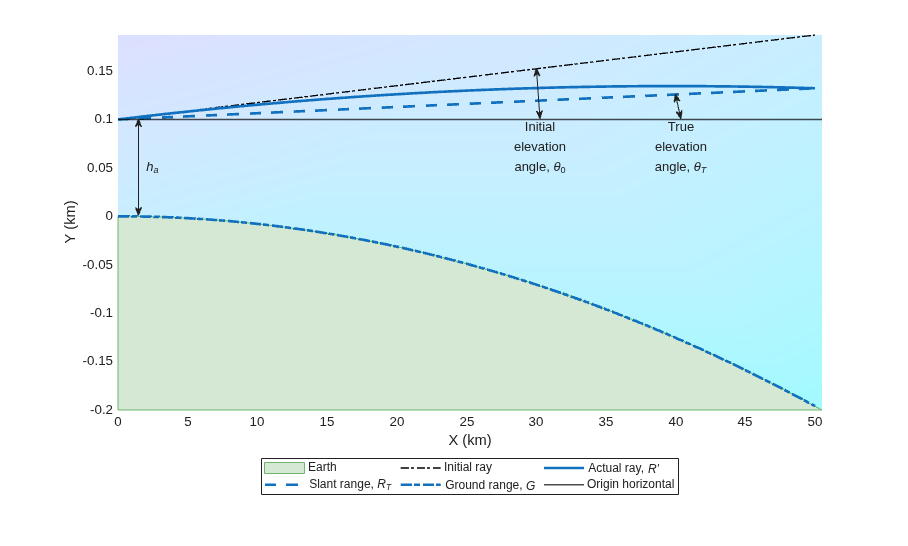
[r,sr,t_el] = height2range(___,Method="CRPL") also returns the straight-line slant range between the target and the sensor, sr, and the elevation angle between the target and the propagated path r, t_el. This syntax is valid when you specify the Earth model as "CRPL".

Examples

collapse all

Compute the range along the propagated path for a target height of 1 km, an antenna height of 10 meters, and an elevation angle of 2 degrees at the radar. Assume a curved Earth model with a 4/3 effective Earth radius.

r = height2range(1e3,10,2)
r = 
2.7125e+04

Compute the range along the propagated path using the CRPL exponential reference atmosphere. Assume a target height of 1 km, an antenna height of 10 meters, and an elevation angle of 2 degrees at the radar. Additionally, compute the true slant range and the true elevation angle to the target.

[R,SRtrue,elTrue] = height2range(1e3,10,2,Method="CRPL")
R = 
2.7171e+04
SRtrue = 
2.7163e+04
elTrue = 
1.9666

Input Arguments

collapse all

Target height specified as a nonnegative scalar or length-M row vector. If tgtht is a vector, it must have the same size as the other vector input arguments of height2range. Heights are referenced to the ground. Units are in meters.

Data Types: double

Sensor height specified as a nonnegative scalar or length-M row vector. If anht is a vector, it must have the same size as the other vector input arguments of height2range. Heights are referenced to the ground. Units are in meters.

Data Types: double

Elevation angle of the sensor, specified as scalar or length-M row vector. The elevation angle is the initial elevation angle of the ray leaving the sensor. If el is a vector, it must have the same size as the other vector input arguments of height2range. Units are in degrees.

Data Types: double

Name-Value Arguments

collapse all

Specify optional pairs of arguments as Name1=Value1,...,NameN=ValueN, where Name is the argument name and Value is the corresponding value. Name-value arguments must appear after other arguments, but the order of the pairs does not matter.

Example: r = height2range(tgtht,anht,el,Method="CRPL",SurfaceRefractivity=300,RefractionExponent=0.15)

Earth model used for the computation, specified as "Curved", "Flat", or "CRPL".

  • "Curved" — Assumes a Curved Earth Model with an effective radius of 4/3 times the actual Earth radius, which is a commonly used approximation for modeling refraction effects in the troposphere. To specify another value for the effective Earth radius, use the EffectiveEarthRadius name-value pair argument.

  • "Flat" — Assumes a Flat Earth Model. In this case, the effective Earth radius is infinite.

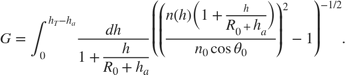
  • "CRPL" — Assumes a curved Earth model with the atmosphere defined by the CRPL Exponential Reference Atmosphere Model with a refractivity of 313 N-units and a refraction exponent of 0.143859 km–1. To specify other values for the refractivity and the refraction exponent, use the SurfaceRefractivity and RefractionExponent name-value arguments. This CRPL Exponential model accounts for refraction at elevation angles greater than approximately 10 millirad (about 0.573 degrees) and heights above approximately 1 km. For more information, see CRPL Model Geometry.

Data Types: char | string

Effective Earth radius in meters, specified as a positive scalar. If this argument is not specified, height2range calculates the effective Earth radius using a refractivity gradient of –39 × 10–9 N-units/meter, which results in approximately 4/3 of the real Earth radius. This argument applies only if Method is specified as "Curved".

Data Types: double

Surface refractivity in N-units, specified as a nonnegative real-valued scalar. The surface refractivity is a parameter of the CRPL Exponential Reference Atmosphere Model used by height2range. This argument applies only if Method is specified as "CRPL".

Data Types: double

Refraction exponent, specified as a nonnegative real-valued scalar. The refraction exponent is a parameter of the CRPL Exponential Reference Atmosphere Model used by height2range. This argument applies only if Method is specified as "CRPL".

Data Types: double

Output Arguments

collapse all

Propagated range between the target and sensor, returned as a scalar or real-valued length-M row vector. If r is a vector, it has the same size as the vector input arguments of height2range. The propagated range is the distance along the slightly curved propagated path that results from atmospheric refraction over long distances and is the range that would be retrieved from measurements acquired by a sensor with pointing geometry defined by tgtht, anht, and el. Units are in meters.

Data Types: double

Slant range, or straight-line geometric distance between sensor and target, returned as a scalar or length-M real-valued row vector. Units are in meters.

Example: 5000.0

Data Types: double

Elevation angle between the target and propagated path r, returned as a scalar or real-valued length-M row vector.

Data Types: double

More About

collapse all

References

[1] Barton, David K. Radar Equations for Modern Radar. Norwood, MA: Artech House, 2013.

[2] Bean, B.R., and G.D. Thayer. "Central Radio Propagation Laboratory Exponential Reference Atmosphere." Journal of Research of the National Bureau of Standards, Section D: Radio Propagation 63D, no. 3 (November 1959): 315. https://doi.org/10.6028/jres.063D.031.

[3] Blake, Lamont V. "Ray Height Computation for a Continuous Nonlinear Atmospheric Refractive-Index Profile." Radio Science 3, no. 1 (January 1968): 85–92. https://doi.org/10.1002/rds19683185.

[4] Doerry, A. W. "Earth Curvature and Atmospheric Refraction Effects on Radar Signal Propagation." Sandia National Laboratories, SAND2012-10690 (Jan. 2013).

Extended Capabilities

expand all

C/C++ Code Generation
Generate C and C++ code using MATLAB® Coder™.

Version History

Introduced in R2021b