dsp.MovingStandardDeviation
R2026bMoving standard deviation
Description
The dsp.MovingStandardDeviation
System object™ computes the moving standard deviation of the input signal along each channel,
independently over time. The object uses either the sliding window method or the exponential
weighting method to compute the moving standard deviation. In the sliding window method, a
window of specified length is moved over the data, sample by sample, and the object computes
the standard deviation over the data in the window. In the exponential weighting method, the
object computes the exponentially weighted moving variance, and takes the square root.
You can make the window length tunable by setting
the EnableTunableWindowLength property to true. In
this mode, use the TunableWindowLength property to change the window
length even after you pass some data to the object and the object is locked. The
MaxWindowLength property specifies the maximum allowed window
length. (since R2026b)
For more details, see Algorithms.
The dsp.MovingStandardDeviation object and the movstd function both compute the moving standard deviation of the input signal.
However, the object can process large streams of real-time data and handle system states
automatically. The function performs one-time computations on data that is readily available
and cannot handle system states. For a comparison between the two, see System Objects vs MATLAB Functions.
To compute the moving standard deviation of the input:
Create the
dsp.MovingStandardDeviationobject and set its properties.Call the object with arguments, as if it were a function.
To learn more about how System objects work, see What Are System Objects?
Creation
Syntax
Description
MovStd = dsp.MovingStandardDeviationMovStd, using the
default properties.
MovStd = dsp.MovingStandardDeviation(Len)WindowLength property to Len.
MovStd = dsp.MovingStandardDeviation(Len,Overlap)WindowLength property to Len and the
OverlapLength property to Overlap.
MovStd = dsp.MovingStandardDeviation(PropertyName=Value)Name=Value
pairs. For example, to specify an exponential weighting factor of
0.88, set ForgettingFactor to
0.88.
Properties
Usage
Syntax
Description
Input Arguments
Output Arguments
Object Functions
To use an object function, specify the
System object as the first input argument. For
example, to release system resources of a System object named obj, use
this syntax:
release(obj)
Examples
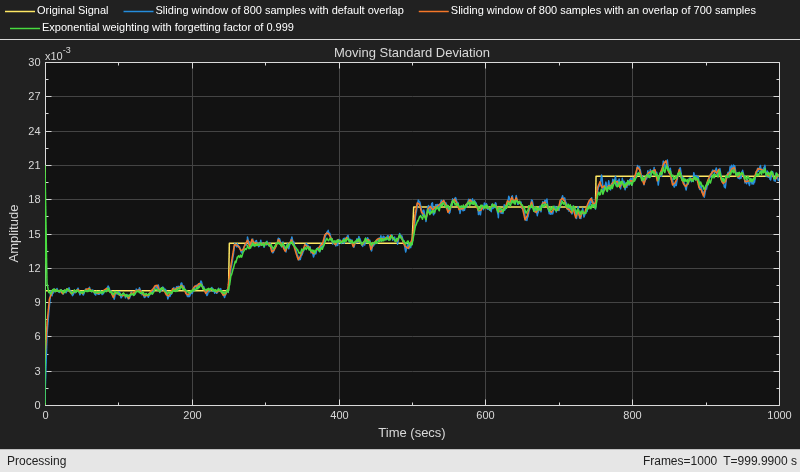
Compute the moving standard deviation of a noisy square wave signal with varying amplitude using the dsp.MovingStandardDeviation object.
Initialization
Set up movstdWindow, movstdWindow_overlap, and movstdExp objects. movstdWindow uses the sliding window method with a window length of 800 samples and a default overlap length of 799 samples, which is one sample less than the specified window length. movstdWindow_overlap uses a window length of 800 samples and an overlap length of 700 samples. movstdExp uses the exponentially weighting method with a forgetting factor of 0.999.
Create a time scope for viewing the output.
FrameLength = 100;
Fs = 100;
movstdWindow = dsp.MovingStandardDeviation(800);
movstdWindow_overlap = dsp.MovingStandardDeviation(800,700);
movstdExp = dsp.MovingStandardDeviation(...
    Method="Exponential weighting",...
    ForgettingFactor=0.999);
scope  = timescope(SampleRate=[Fs,Fs,Fs/(800-700),Fs],...
    TimeSpanOverrunAction="Scroll",...
    TimeSpanSource="Property",...
    TimeSpan=1000,...
    ShowGrid=true,...
    BufferLength=1e7,...
    YLimits=[0 3e-2]);
title = "Moving Standard Deviation";
scope.Title = title;
scope.ChannelNames = {"Original Signal",...
    "Sliding window of 800 samples with default overlap",...
    "Sliding window of 800 samples with an overlap of 700 samples",...
    "Exponential weighting with forgetting factor of 0.999"};
Compute the Standard Deviation
Generate a noisy square wave signal. Vary the amplitude of the square wave after a given number of frames. Apply the sliding window method and the exponential weighting method to this signal. The actual standard deviation is sqrt(np). The object uses this value while adding noise to the data. Compare the actual standard deviation with the computed standard deviation in the time scope.
count = 1;
noisepower = 1e-4 * [1 2 3 4];
for index = 1:length(noisepower)
    np = noisepower(index);
    yexp = sqrt(np)*ones(FrameLength,1);
    for i = 1:250
        x = sqrt(np) * randn(FrameLength,1);
        y1 = movstdWindow(x);
        y2 = movstdWindow_overlap(x);
        y3 = movstdExp(x);
        scope(yexp,y1,y2,y3);
    end
end
Since R2026b
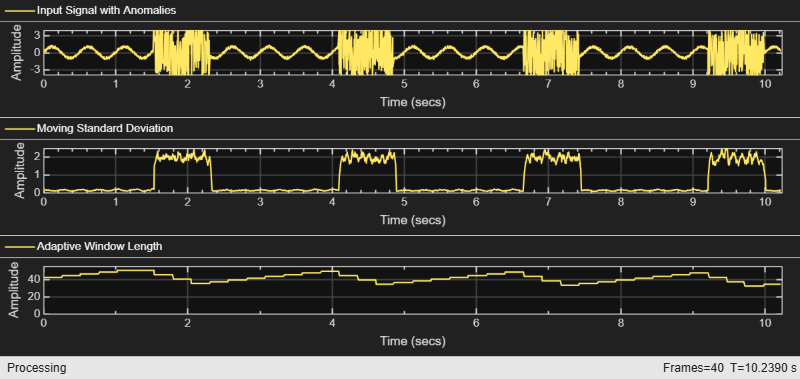
Compute the moving standard deviation of a noisy sinusoidal signal and adapt the window length based on the noise level. Use a longer window when the noise is light for a stable estimate and a shorter window when the noise is heavy for faster tracking.
Create Input Signal
Create a sine wave signal with a frequency of 2 Hz to simulate a baseline sensor reading. Set the sampling rate to 1000 Hz and the frame size to 256 samples.
Fs = 1000;
frameSize = 256;
numFrames = 40;
sine = dsp.SineWave(Frequency=2,SampleRate=Fs,...
    SamplesPerFrame=frameSize);
Create Moving Standard Deviation Object
Create a dsp.MovingStandardDeviation object with tunable window length enabled. Set the maximum window length to 50 and the initial tunable window length to 40 (long window for stable baseline). Enable auto-adjustment to handle edge cases.
movStd = dsp.MovingStandardDeviation(EnableTunableWindowLength=true,...
    TunableWindowLength=40,...
    MaxWindowLength=50,...
    AutoAdjustInvalidWindowLength=true)
movStd =
  dsp.MovingStandardDeviation with properties:

                           Method: 'Sliding window'
              SpecifyWindowLength: true
        EnableTunableWindowLength: true
              TunableWindowLength: 40
                  MaxWindowLength: 50
    AutoAdjustInvalidWindowLength: true
Create a timescope object to view the input signal, moving standard deviation output, and the adaptive window length.
scope = timescope(SampleRate=Fs,...
    TimeSpanSource="property",TimeSpan=numFrames*frameSize/Fs,...
    TimeSpanOverrunAction="Scroll",...
    ShowGrid=true,...
    LayoutDimensions=[3 1],...
    NumInputPorts=3, ...
    ChannelNames=["Input Signal with Anomalies",...
    "Moving Standard Deviation","Adaptive Window Length"]);
scope.ActiveDisplay = 1;
scope.YLimits = [-4 4];
scope.ActiveDisplay = 2;
scope.YLimits = [0 2.5];
scope.ActiveDisplay = 3;
scope.YLimits = [0 55];
Apply Adaptive Anomaly Detection
Add Gaussian noise whose power grows linearly over time. At each frame, set the window length inversely proportional to the noise power. A shorter window produces a standard deviation estimate that reacts quickly to sudden changes, while a longer window produces a smoother, more stable estimate.
threshold = 0.5;
wl = 40;
for idx = 1:numFrames
    x = sine();

    % Inject anomaly bursts at specific frames
    if mod(idx,10) >= 7 && mod(idx,10) <= 9
        x = x + 2*randn(frameSize,1);
    else
        x = x + 0.1*randn(frameSize,1);
    end

    % Compute moving standard deviation
    movStd.TunableWindowLength = wl;
    y = movStd(x);

    % Adapt window length based on current standard deviation
    avgStd = mean(y);
    if avgStd > threshold
        wl = max(5,wl - 5);
    else
        wl = min(50,wl + 2);
    end

    % Display results
    scope(x,y,wl*ones(frameSize,1));
end
Since R2026b
Generate C code for a moving standard deviation computation with a tunable window length parameter. Verify that the window length appears as a tunable parameter in the generated code.
Create Entry-Point Function
Create an entry-point function that instantiates a dsp.MovingStandardDeviation object with tunable window length enabled. The function accepts a data input and a tunable window length value.
type movingStdTunableWL.mfunction y = movingStdTunableWL(x,wl) %#codegen
%movingStdTunableWL Moving standard deviation with tunable window length
% y = movingStdTunableWL(x,wl) computes the moving standard deviation of
% the input x using a window length that can be changed at runtime.
persistent movStd
if isempty(movStd)
movStd = dsp.MovingStandardDeviation(EnableTunableWindowLength=true,...
MaxWindowLength=31,...
AutoAdjustInvalidWindowLength=true);
end
movStd.TunableWindowLength = wl;
y = movStd(x);
end
Generate C Code
Generate C code for the entry-point function using codegen. Specify the input data as a 256-by-1 column vector of doubles and the window length as a scalar double.
codegen movingStdTunableWL -args {zeros(256,1),0} -config:lib -report
Code generation successful: View report
Verify Tunable Parameter in Generated Code
Inspect the generated code to verify that TunableWindowLength appears as a parameter that can be changed at runtime without regenerating code.
The generated code contains the TunableWindowLength field in the persistent object state, confirming that you can change the window length at runtime in the deployed code.
Algorithms
In the sliding window method, the output at the current sample is the standard deviation of the current sample with respect to the data in the window. To compute the first output sample, the algorithm waits until it receives the hop size number of input samples. Hop size is defined as window length – overlap length. Remaining samples in the window are considered to be zero. As an example, if the window length is 5 and the overlap length is 2, then the algorithm waits until it receives 3 samples of input to compute the first sample of the output. After generating the first output, it generates the subsequent output samples for every hop size number of input samples.
When you do not specify the window length, the algorithm chooses an infinite window length. In this mode, the output is the moving standard deviation of the current sample with respect to all the previous samples in the channel.
Consider an example of computing the moving standard deviation of a streaming input data using the sliding window method. The algorithm uses a window length of 4 and an overlap length of 3. With each input sample that comes in, the window of length 4 moves along the data.
![Sliding window method for moving standard deviation with window length 4 and input samples [-1, -2, 3, 2, 5, 2]. At each time step n=0 through n=5, the window fills with zeros until length 4 is reached, then moves along the data. Moving standard deviation computes std for each window position, producing values 0.5, 0.957, 2.16, 2.38, 2.944, 1.414 at n=5](movstd_slidewin.png)
In the exponential weighting method, the moving standard deviation is computed recursively using these formulas:
— Moving standard deviation of the current data sample with respect to the rest of the data.
— Difference between each data sample and the average of the data, squared.
— Difference between each data sample and the average of the data, squared and multiplied with the forgetting factor. All the squared terms are added.
— Weighting factor applied to the sum.
λ — Forgetting factor.
As the age of the data increases, the magnitude of the weighting factor decreases exponentially and never reaches zero. In other words, the recent data has more influence on the current standard deviation than the older data.
The value of the forgetting factor determines the rate of change of the weighting factors. A forgetting factor of 0.9 gives more weight to the older data than does a forgetting factor of 0.1. A forgetting factor of 1.0 indicates infinite memory. All previous samples are given an equal weight.
Consider an example of computing the moving standard deviation using the exponential weighting method. The forgetting factor is 0.9.
![Exponential weighting method for moving standard deviation with forgetting factor 0.9. Three input frames: [2,3,4,5] at n=0 producing outputs [0, 0.7071, 0.9991, 1.2879], [6,7,8,9] at n=1 producing outputs [1.5742, 1.8578, 2.1386, 2.4161], and [3,4,6,8] at n=2 producing outputs [2.5004, 2.3625, 2.1886, 2.2314]](movstd_expwei.png)
References
[1] Bodenham, Dean. “Adaptive Filtering and Change Detection for Streaming Data.” PH.D. Thesis. Imperial College, London, 2012.
Extended Capabilities
Version History
Introduced in R2016bSee Also
Functions
Objects
dsp.MovingMaximum|dsp.MovingMinimum|dsp.MovingAverage|dsp.MovingRMS|dsp.MovingVariance|dsp.MedianFilter

