numerical double integral of an expression with vector defined variables
Show older comments
Hi everyone,
I have to compute double integral for the expression G over phi and theta in the following code numerically. Does anyone have any idea how it must be done, since it is not easy to use trapz or integral2 because of the definition of the variables!
c = 4.2;
d = 10;
r3 = linspace(c, d, 100);
theta = linspace(-pi/2, pi/2, 100);
theta2 = linspace(-pi/2 ,pi/2, 100);
Phi = linspace(0, 2*pi, 100);
Phi2 = linspace(0, 2*pi, 100);
G = r3.*(sin(theta2).*cos(theta).*cos(phi2-phi) - cos(theta2).*sin(theta)) ./(r3.^2 + c.^2 - 2.*r3.*c.*(sin(theta2).*sin(theta).*cos(phi2-phi)+cos(theta2).*cos(theta))).^3/2 ;
Accepted Answer

darova
on 9 Apr 2020
Here is a start
phi = linspace(...) % define value for phi
theta = linspace(...); % define theta
dphi = phi(2)-phi(1); % phi step
dtheta = theta(2)-theta(1); % theta step
[PHI,THETA] = meshgrid(phi,theta); % create 2D grid
G = PHI .. THETA ... % calculate G at each point of grid
F = G(1:end-1,1:end-1) + G(1:end-1,2:end) + G(2:end,1:end-1) + G(2:end,2:end);
result = sum(F(:))/4*dphi*dtheta*
Do you know why F variable is so long?
5 Comments

Nima
on 12 Apr 2020
darova
on 12 Apr 2020
I don't understand your new issue. Can you explain? Are you trying to calculate 3 integral now?
I assumed that you are trying to find volume under the surface. I simply replaced Z value with mean value of 4 neighbour vertices. So elementary volume is 


I didn't notice before that you are trying to calculate something in spherical system. Elementary volume is spherical as following (volume at the top (  ) is small and volume at
  is bigger)
) is small and volume at is bigger)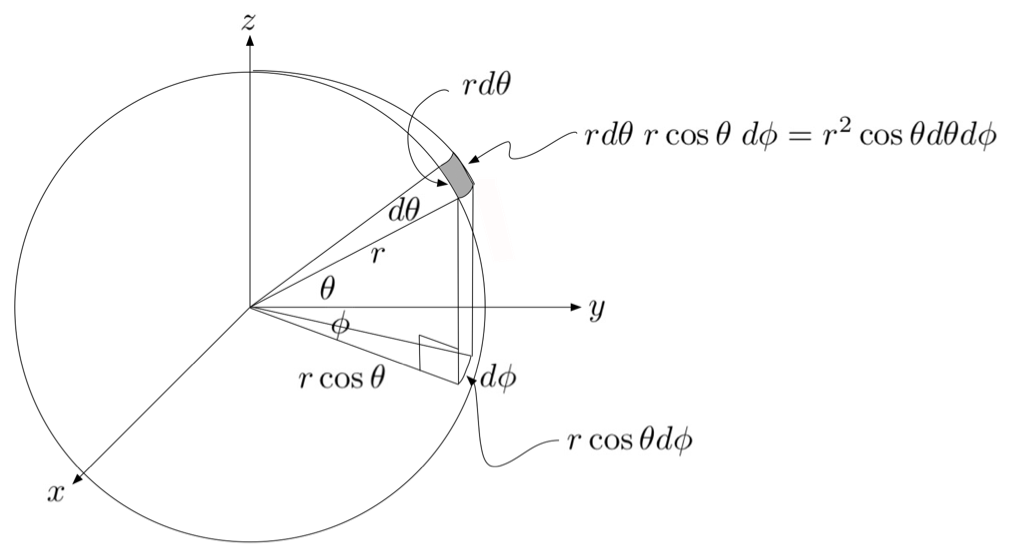
So my previous code should be like this
phi = linspace(...) % define value for phi
theta = linspace(...); % define theta
dphi = phi(2)-phi(1); % phi step
dtheta = theta(2)-theta(1); % theta step
[PHI,THETA] = meshgrid(phi,theta); % create 2D grid
G = PHI .. THETA ... % calculate G at each point of grid
F = G(1:end-1,1:end-1) + G(1:end-1,2:end) + G(2:end,1:end-1) + G(2:end,2:end);
F = F .* R^2 .* cos(theta(2:end,2:end)); % correction of elementary volume
result = sum(F(:))/4*dphi*dtheta*
Nima
on 12 Apr 2020
darova
on 12 Apr 2020
Sorry, big THETA here
F = F .* R^2 .* cos(THETA(2:end,2:end)); % correction of elementary volume
It's late today. Im going to sleep. I'll respond tomorrow
darova
on 13 Apr 2020
As for volume calculations:

I suggest you to use 3D matrices:
theta = ...
phi = ..
rr = ...
dth = theta(2) - theta(1);
dphi = phi(2) - phi(1);
dr = rr(2) - rr(1);
[T,P,R] = meshgrid(theta,phi,rr); % create 3D matrices
Integral 3
dV = (your long function) .* R.^2 .*cos(T) *dr*dth*dphi;
Now there is need to 'averaging' as before but for 3D matrices
Maybe there is better idea but i have only this:
dV = dV(1:end-1,1:end-1,1:end-1) + ...
dV(1:end-1,1:end-1,2:end) + ...
dV(1:end-1,2:end,1:end-1) + ...
dV(2:end,2:end,1:end-1) + ...
% 4 more combinations
dV = sum(dV(:))/8;
There is one more idea, but nor precise one (without averaging). Just create dense mesh
dV1 = dV(2:end,2:end,2:end);
dV1 = sum(dV1);
More Answers (0)
Categories
Find more on Programming in Help Center and File Exchange
Products
Community Treasure Hunt
Find the treasures in MATLAB Central and discover how the community can help you!
Start Hunting!
