wlanTGacChannel
R2026bFilter signal through 802.11ac multipath fading channel
Description
The wlanTGacChannel
System object™ filters an input signal through an 802.11ac™ (TGac) multipath fading channel.
The fading processing assumes the same parameters for all NT-by-NR links of the TGac channel, where NT is the number of transmit antennas and NR is the number of receive antennas. Each link comprises all multipaths for that link.
To filter an input signal using a TGac multipath fading channel:
Create the
wlanTGacChannelobject and set its properties.Call the object with arguments, as if it were a function.
To learn more about how System objects work, see What Are System Objects?
Creation
Description
tgac = wlanTGacChanneltgac. This object filters a real or complex input
signal through the TGac channel to obtain the channel-impaired signal.
tgac = wlanTGacChannel(PropertyName=Value)tgac, and sets
properties using one or more name-value arguments. Enclose each
property name in quotes. For example,
wlanTGacChannel(NumReceiveAntennas=2,SampleRate=10e6)
creates a TGac channel with two receive antennas and a 10 MHz sample
rate.
Properties
Usage
Description
[
also returns in y,pathGains] = tgac(x)pathGains the TGac channel path gains of the
underlying fading process.
This syntax applies when you set the PathGainsOutputPort property to 1
(true).
Input Arguments
Output Arguments
Object Functions
To use an object function, specify the
System object as the first input argument. For
example, to release system resources of a System object named obj, use
this syntax:
release(obj)
Note
reset: If the
RandomStream property of the System object is set to "Global stream", the reset function resets the filters only. If
you set RandomStream to "mt19937ar with
seed", the reset function
not only resets the filters, but also reinitializes the random number
stream to the value of the Seed property. This
results in the same channel realization.
Examples
Generate a VHT waveform and pass it through a TGac SISO channel. Display the spectrum of the resultant signal.
Set the channel bandwidth and the corresponding sample rate.
bw = "CBW80";
fs = 80e6;
Generate a VHT waveform.
cfg = wlanVHTConfig;
txSig = wlanWaveformGenerator(randi([0 1],1000,1),cfg);
Create a TGac SISO channel with path loss and shadowing enabled.
tgacChan = wlanTGacChannel(SampleRate=fs,ChannelBandwidth=bw, ...
    LargeScaleFadingEffect="Pathloss and shadowing");
Pass the VHT waveform through the channel.
rxSig = tgacChan(txSig);
Plot the spectrum of the received waveform.
saScope = spectrumAnalyzer(SampleRate=fs,YLimits=[-120 -40]);
saScope(rxSig)
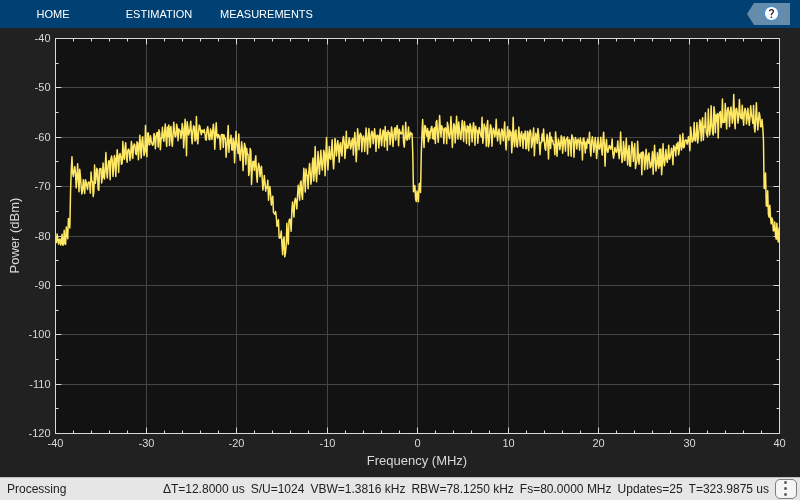
Because path loss and shadowing are enabled, the mean received power across the spectrum is approximately –60 dBm.
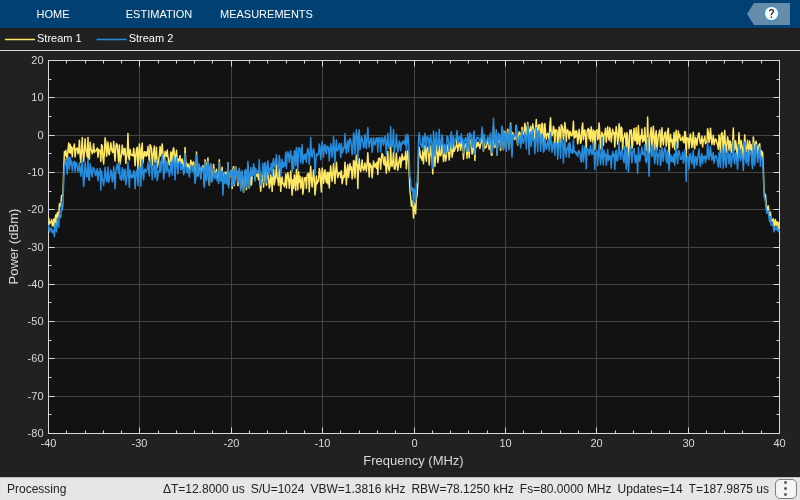
Create a VHT waveform with four transmit antennas and two space-time streams.
cfg = wlanVHTConfig(NumTransmitAntennas=4,NumSpaceTimeStreams=2, ...
    SpatialMapping="Fourier");
txSig = wlanWaveformGenerator([1;0;0;1],cfg);
Create a 4x2 MIMO TGac channel and disable large-scale fading effects.
tgacChan = wlanTGacChannel(SampleRate=80e6,ChannelBandwidth="CBW80", ...
    NumTransmitAntennas=4,NumReceiveAntennas=2, ...
    LargeScaleFadingEffect="None");
Pass the transmit waveform through the channel.
rxSig = tgacChan(txSig);
Display the spectrum of the two received space-time streams.
saScope = spectrumAnalyzer(SampleRate=80e6, ...
    ShowLegend=true, ...
    ChannelNames={'Stream 1','Stream 2'});
saScope(rxSig)
Transmit a VHT-LTF and a VHT data field through a noisy 2x2 MIMO channel. Demodulate the received VHT-LTF to estimate the channel coefficients. Recover the VHT data and determine the number of bit errors.
Set the channel bandwidth and corresponding sample rate.
rng(0,"twister");
bw = "CBW160";
fs = 160e6;
Create VHT-LTF and VHT data fields with two transmit antennas and two space-time streams.
cfg = wlanVHTConfig(ChannelBandwidth=bw, ...
    NumTransmitAntennas=2,NumSpaceTimeStreams=2);
txPSDU = randi([0 1],8*cfg.PSDULength,1);
txLTF = wlanVHTLTF(cfg);
txDataSig = wlanVHTData(txPSDU,cfg);
Create a 2x2 MIMO TGac channel.
tgacChan = wlanTGacChannel(SampleRate=fs,ChannelBandwidth=bw, ...
    NumTransmitAntennas=2,NumReceiveAntennas=2,NormalizeChannelOutputs=false);
Pass the signals through the TGac channel and add noise
snrdB = 15; % SNR (dB)
% Convert the SNR per active subcarrier to total SNR to account for noise energy in null subcarriers
ofdmInfo = wlanVHTOFDMInfo("VHT-LTF",cfg);
snrValue = convertSNR(snrdB,"snrsc","snr",FFTLength=ofdmInfo.FFTLength,NumActiveSubcarriers=ofdmInfo.NumTones);
nVar = 10^((-snrValue-30)/10); % Noise variance (W) for 0 dBm (-30 dBW) signal power
rxLTF = awgn(tgacChan(txLTF),snrValue);
rxDataSig = awgn(tgacChan(txDataSig),snrValue);
Demodulate the VHT-LTF. Use the demodulated signal to estimate the channel coefficients.
dLTF = wlanVHTDemodulate(rxLTF,"VHT-LTF",cfg);
chanEst = wlanVHTLTFChannelEstimate(dLTF,cfg);
Recover the data and determine the number of bit errors.
vhtdatasym = wlanVHTDemodulate(rxDataSig,"VHT-Data",cfg);
[eqSym,csi] = wlanVHTEqualize(vhtdatasym,chanEst,nVar,cfg,"VHT-Data");
rxPSDU = wlanVHTDataBitRecover(eqSym,nVar,csi,cfg);
numErr = biterr(txPSDU,rxPSDU)
numErr =
0
Create a non-HT configuration object with default parameters. Generate a waveform for the configuration.
cfg = wlanNonHTConfig;
tx = wlanWaveformGenerator([1;0;0;1],cfg);
Create a TGn channel System object with default parameters. Display the value of the RandomStream property.
tgnChan = wlanTGnChannel;
disp(tgnChan.RandomStream)
Global stream
Pass the waveform through the channel twice, resetting the System object between the two iterations.
for i = 1:2
    rx(:,i) = tgnChan(tx);
    reset(tgnChan);
end
Compare the two received waveforms. They are different because the reset object function resets the filters and the channel object takes new random numbers from the global stream. This causes it to generate a different channel realization.
isequal(rx(:,1),rx(:,2))
ans = logical
   0
Now release the System object and set the RandomStream property to "mt19937ar with seed".
release(tgnChan);
tgnChan.RandomStream = "mt19937ar with seed";
Pass the waveform through the channel twice, resetting the System object between the two iterations.
for i = 1:2
    rx(:,i) = tgnChan(tx);
    reset(tgnChan);
end
Compare the two received waveforms. They are equal because the channel realization is the same for both iterations. This happens because the reset function reinitializes the random number stream to the value of the Seed property, so the channel object uses the same random numbers for both channel realizations.
isequal(rx(:,1),rx(:,2))
ans = logical
   1
Algorithms
References
[1] Erceg, V., L. Schumacher, P. Kyritsi, et al. TGn Channel Models. Version 4. IEEE 802.11-03/940r4, May 2004.
[2] Breit, G., H. Sampath, S. Vermani, et al.TGac Channel Model Addendum. Version 12. IEEE 802.11-09/0308r12, March 2010.
[3] Kermoal, J. P., L. Schumacher, K. I. Pedersen, P. E. Mogensen, and F. Frederiksen. “A Stochastic MIMO Radio Channel Model with Experimental Validation”. IEEE Journal on Selected Areas in Communications 20, No. 6 (August 2002): pp. 1211–1226.

