SParameterChannel
R2026bConvert S-parameter to impulse response
Description
The SParameterChannel object combines the scattering parameter
(S-parameter) model of a baseband communication channel with an analog transmitter and
receiver into a single S-parameter with adjustable port ordering. The object then calculates
the impulse response of the S-Parameter using the rational (RF Toolbox) function.
The SParameterChannel object supports .sNp Touchstone files, where N represents the number of ports.
Creation
Description
creates an S-parameter channel object obj = SParameterChannel(filename)obj by importing data from the
Touchstone file specified by filename.
Input Arguments
Touchstone data file that contains network parameter data, specified as a character
vector or string scalar. filename can be the name of a file on
the MATLAB® path or the full path to a file.
The data file can be formatted either as a Touchstone 1.1 or Touchstone 2.0 file. (since R2023b)
Properties
The name of the Touchstone data file from where you want to import the S-parameter data, specified as a character vector or string scalar.
Data Types: char | string
Define how the incoming signal is transmitted through wires:
differential— Transmit the incoming signal using a differential pair of signals. The receiver responds to the difference between the two signals.single-ended— Transmit the incoming signal using a varying voltage. The receiver responds to the difference between the incoming signal and a reference or ground.
Port order for the S-parameter, specified as a character vector. If left blank, the function automatically detects the through paths and the re-orders the ports in the order [in1 out1 in2 out2].
Example: [1 2 3 4]
Data Types: char
Maximum number of poles to use to fit a rational model, specified as a positive scalar integer.
Data Types: double
Desired error tolerance for rational model fit, specified as a real scalar in dB.
Data Types: double
Sample interval of the impulse response, specified as a positive real scalar in seconds.
Data Types: double
Desired duration of the impulse response, specified as a positive real scalar in
seconds. The total number of samples in the impulse response is calculated by dividing
the StopTime property by SampleInterval
property.
Data Types: double
Single-ended resistance of the transmitter analog model on the left side of the S-parameter, specified as a nonnegative real scalar in ohms.
Data Types: double
Capacitance of the transmitter analog model on the left side of the S-parameter, specified as a nonnegative real scalar in farads.
Data Types: double
Amplitude of the stimulus input to the transmitter analog model, specified as a real scalar.
Data Types: double
20%–80% rise time of the stimulus input to the transmitter analog model, specified as a positive real scalar in seconds.
Data Types: double
Single-ended resistance of the receiver analog model on the right side of the S-parameter, specified as a nonnegative real scalar in ohms.
Data Types: double
Single-ended impedance of the receiver analog model on the right side of the S-parameter, specified as a nonnegative real scalar in ohms.
Data Types: double
Option to acquire aggressor behavior, specified as:
same-load— The stimulus is applied to each aggressor input and probed at the victim output.same-source— The stimulus is applied to the victim input and probed at the aggressor output.
The same-load definition is more direct. But the
same-source definition is used by methodologies that rely on time
domain excitation, such as HSPICE, to stimulate the system with a single pulse or step
response.
Simultaneous Bi-Directional Architecture Style, specified as none
or ReplicaSummer.
Single-ended resistance of the receiver analog model on the left side of the S-parameter, specified as a nonnegative real scalar in ohms.
Data Types: double
Capacitance of the receiver analog model on the left side of the S-parameter, specified as a nonnegative real scalar in farads.
Data Types: double
Single-ended resistance of the transmitter analog model on the right side of the S-parameter, specified as a nonnegative real scalar in ohms.
Data Types: double
Capacitance of the transmitter analog model on the right side of the S-parameter, specified as a nonnegative real scalar in farads.
Data Types: double
Automatically detect port order.
This property is read-only.
Port order used for the S-parameter channel analysis, returned as a vector. If you
do not define the port order using PortOrder property, the through
paths are automatically detected and reported here.
Data Types: double
This property is read-only.
Impulse response of the system defined by the S-parameter channel object, returned as a vector.
Data Types: double
This property is read-only.
Time vector corresponding to the system impulse responses, returned as a vector.
Data Types: double
This property is read-only.
S-parameter frequencies, specified as a positive real-valued vector. The frequencies are sorted from the smallest to the largest value.
Data Types: double
This property is read-only.
Transfer function of the system defined by the S-parameter channel object, returned as a vector.
Data Types: double
This property is read-only.
Output statistics from rational (RF Toolbox), returned as an
object.
Data Types: double
This property is read-only.
Uncertainty due to rise time discretization, returned as a negative real scalar.
Data Types: double
Examples
Create an S-parameter channel object.
obj = SParameterChannel('FileName','default.s4p');
Extract the time vectors and impulse responses.
t = obj.t; impulse = obj.ImpulseResponse;
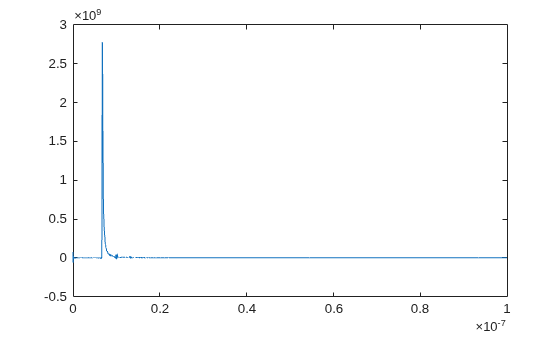
Plot the impulse response.
plot(t,impulse);
Version History
Introduced in R2021aDesign bidirectional links in the SerDes Simulink® models.
The SparameterChannel object now allows you to input a Touchstone 2.0 data file as an input argument.
See Also
rational (RF Toolbox) | Analog Channel | serdes.ChannelLoss
MATLAB Command
You clicked a link that corresponds to this MATLAB command:
Run the command by entering it in the MATLAB Command Window. Web browsers do not support MATLAB commands.
Select a Web Site
Choose a web site to get translated content where available and see local events and offers. Based on your location, we recommend that you select: .
You can also select a web site from the following list
How to Get Best Site Performance
Select the China site (in Chinese or English) for best site performance. Other MathWorks country sites are not optimized for visits from your location.
Americas
- América Latina (Español)
- Canada (English)
- United States (English)
Europe
- Belgium (English)
- Denmark (English)
- Deutschland (Deutsch)
- España (Español)
- Finland (English)
- France (Français)
- Ireland (English)
- Italia (Italiano)
- Luxembourg (English)
- Netherlands (English)
- Norway (English)
- Österreich (Deutsch)
- Portugal (English)
- Sweden (English)
- Switzerland
- United Kingdom (English)