Anatomy Volume Analysis

MATLAB class to fill models with points, build watertight hulls, and derive volume models of a complex surface model for anatomical analysis

You are now following this Submission

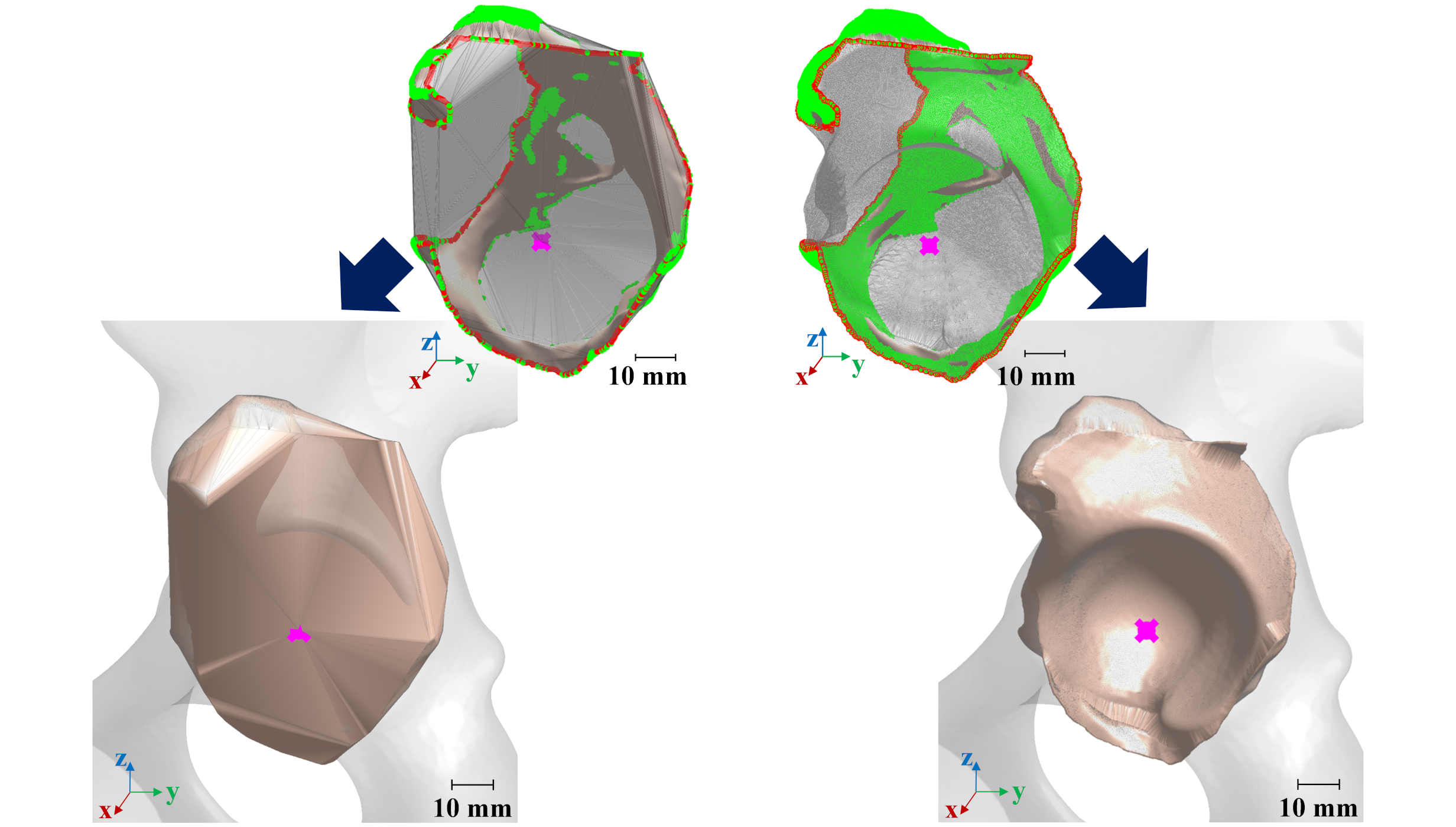
The MATLAB class Anatomy Volume Analysis provides a volume-oriented workflow for anatomical surface meshes. It detects boundary loops, patches holes, generates shrink-wrapped surfaces, reconstructs surfaces from point clouds, fills regions with structured point sets for intersection/volume computations, and supports acetabulum region subdivision for defect volume analysis. The volume class is for geometry-processing tasks where robust, watertight models and volumetric point sets are required.
Key Features:
1. Edge Detection: Boundary vertex/edge extraction and automatic loop grouping
2. Hole Patching: Fill holes with triangulated patches
3. Point Filling: Fill reference and anatomical model with points (grid points)
4. Shrink-Wrap Surfaces: Alpha shape hulls with UI or auto iteration to closed meshes
5. Reference Intersection Support: Identification of reference model parts within alpha shape hulls and assignment of grid points for subsequent volume/intersection steps
6. Point Filtering: Remove grid points outside anatomical model
7. Volume Reconstruction: Refined alpha shape hull with grid points
8. Acetabulum Region Subdivision: Definition of cuboid, sector-based, and hybrid acetabulum sub-regions for regional defect analysis
9. Defect Quantification and Visualization: Assignment of defect grid points to anatomical sub-regions and radar-plot visualization of regional volume loss
How to Use:
1. Code structure: The volume class can be integrated into a corresponding main script. The key parts of the code are extracted into individual functions for reuse. Provide the mesh as an STL file (triangulated).
2. Import: Import the anatomical model data and any reference model in STL format.
3. Run Volume Calculations
4. Results: Use the grid points, closed hulls, and assigned anatomical sub-regions for voxel/point-based volume, intersection, and regional defect analysis.
5. Visualization: Use sector surface plots and radar plots to visualize acetabulum sub-regions and regional defect distributions.
Use Cases:
  • Generating watertight hulls from surface meshes
  • Preparing regions for voxel/point intersection and volume computation
  • Reconstructing surfaces from point clouds
  • Computing distance maps for quantitative mesh comparison
  • Assigning defect grid points to acetabulum cuboid, sector, or hybrid regions
  • Visualizing regional defect distributions with radar plots
Benefits:
  • Robust to real data: handles holes, open boundaries, and noisy points
  • Interactive where needed: quick UI checks
  • Automatable: workflow with auto-closure of alpha shapes
  • Volume-ready outputs: inside/outside masks, alpha shapes, and dense grid points
  • Modular: single functions can be dropped into custom workflows
  • Region-specific: supports cuboid, sector-based, and hybrid acetabulum defect evaluation
Keywords:
anatomy, volume analysis, shrink wrap, alpha shape, mesh repair, hole filling, boundary detection, clustering, KDE, DBSCAN, point cloud, defect filling, watertight mesh, biomedical geometry, acetabulum, cuboid regions, sector regions, hybrid regions, defect analysis, radar plot, regional volume loss
References:

Cite As

Carina Micheler (2026). Anatomy Volume Analysis (https://se.mathworks.com/matlabcentral/fileexchange/181321-anatomy-volume-analysis), MATLAB Central File Exchange. Retrieved .

Micheler, Carina M., et al. “A Comprehensive Computational Workflow for Patient-Specific 3D Reconstruction and Quantitative Analysis of Acetabular Revision Defects.” IEEE Access, vol. 13, 2025, pp. 190238–58, https://doi.org/10.1109/access.2025.3626705.

View more styles

General Information

MATLAB Release Compatibility

  • Compatible with any release

Platform Compatibility

  • Windows
  • macOS
  • Linux
Version Published Release Notes Action
1.0.4

Added acetabulum-specific functions for cuboid, sector-based, and hybrid region analysis. The update enables assignment and quantification of defect grid points per region, with additional visualization using sector surface plots and radar plots.

1.0.3

Publication added

1.0.2

Update files

1.0.1

Update description

1.0.0