AC Voltage Source
R2026bIdeal constant voltage source
AC Voltage Source block

To add a block to a model, double-click the canvas and start typing the block name. Then, select the block from the list.
Libraries:
Simscape /
Foundation Library /
Electrical /
Electrical Sources
Description
The AC Voltage Source block represents an ideal voltage source that maintains sinusoidal voltage across its output terminals, independent of the current flowing through the source.
The output voltage is defined by the following equation:
where:
V is voltage.
V0 is peak amplitude.
f is frequency.
φ is phase shift.
t is time.
Connections + and - are conserving electrical ports corresponding to the positive and negative terminals of the voltage source, respectively. The current is positive if it flows from positive to negative, and the voltage across the source is equal to the difference between the voltage at the positive and the negative terminal, V(+) – V(-).
Examples
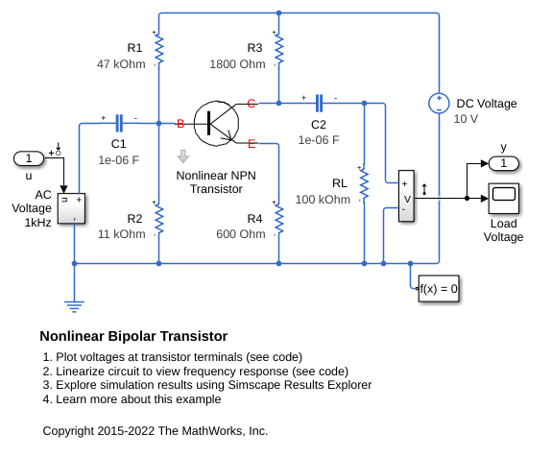
Nonlinear Bipolar Transistor
An implementation of a nonlinear bipolar transistor based on the Ebers-Moll equivalent circuit. R1 and R2 set the nominal operating point, and the small signal gain is approximately set by the ratio R3/R4. The 1uF decoupling capacitors have been chosen to present negligible impedance at 1KHz. The model is configured for linearization so that a frequency response can be generated.
Ports
Conserving
Parameters
Programmatic Use: Add Block
To add the block programmatically, use the add_block function with one of these library block paths as the source.
"fl_lib/Electrical/Electrical Sources/AC Voltage Source"
Example: add_block("fl_lib/Electrical/Electrical Sources/AC Voltage Source","myModel/myBlock",MakeNameUnique="on")
For information about programmatic access to individual block parameters, see the Programmatic Use section of parameter descriptions on this page.
Extended Capabilities
Version History
Introduced in R2007a

