trainoss
R2026b(To be removed) One-step secant backpropagation
trainoss will be removed in a future release. For more information,
see Transition Legacy Neural Network Code to dlnetwork Workflows.
For advice on updating your code, see Version History.
Syntax
net.trainFcn = 'trainoss'

[net,tr] = train(net,...)
Description
trainoss is a network training function that updates weight and
bias values according to the one-step secant method.
net.trainFcn = 'trainoss' sets the network
trainFcn property.
[net,tr] = train(net,...) trains the network with
trainoss.
Training occurs according to trainoss training parameters, shown
here with their default values:
net.trainParam.epochs | 1000 | Maximum number of epochs to train |
net.trainParam.goal | 0 | Performance goal |
net.trainParam.max_fail | 6 | Maximum validation failures |
net.trainParam.min_grad | 1e-10 | Minimum performance gradient |
net.trainParam.searchFcn | 'srchbac' | Name of line search routine to use |
net.trainParam.show | 25 | Epochs between displays ( |
net.trainParam.showCommandLine | false | Generate command-line output |
net.trainParam.showWindow | true | Show training GUI |
net.trainParam.time | inf | Maximum time to train in seconds |
Parameters related to line search methods (not all used for all methods):
net.trainParam.scal_tol | 20 | Divide into |
net.trainParam.alpha | 0.001 | Scale factor that determines sufficient reduction in
|
net.trainParam.beta | 0.1 | Scale factor that determines sufficiently large step size |
net.trainParam.delta | 0.01 | Initial step size in interval location step |
net.trainParam.gama | 0.1 | Parameter to avoid small reductions in performance, usually
set to |
net.trainParam.low_lim | 0.1 | Lower limit on change in step size |
net.trainParam.up_lim | 0.5 | Upper limit on change in step size |
net.trainParam.maxstep | 100 | Maximum step length |
net.trainParam.minstep | 1.0e-6 | Minimum step length |
net.trainParam.bmax | 26 | Maximum step size |
Network Use
You can create a standard network that uses trainoss with
feedforwardnet or cascadeforwardnet. To
prepare a custom network to be trained with trainoss:
Set
net.trainFcnto'trainoss'. This setsnet.trainParamtotrainoss’s default parameters.Set
net.trainParamproperties to desired values.
In either case, calling train with the resulting network trains the
network with trainoss.
Examples
This example shows how to train a neural network using the trainoss train function.
Here a neural network is trained to predict body fat percentages.
[x, t] = bodyfat_dataset;
net = feedforwardnet(10, 'trainoss');
net = train(net, x, t);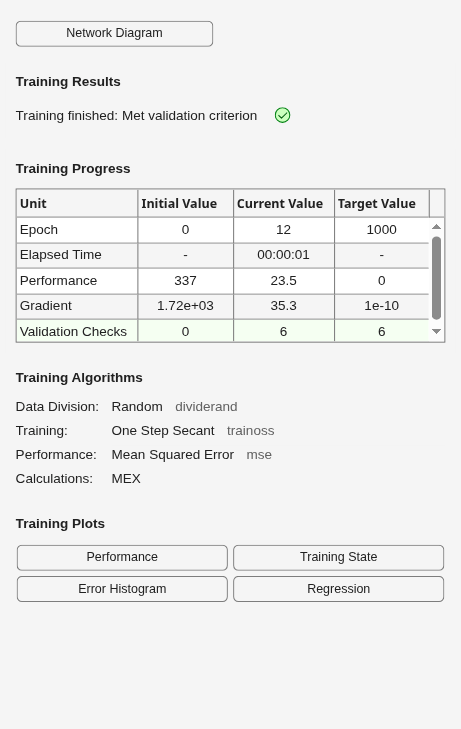
y = net(x);
More About
Algorithms
trainoss can train any network as long as its weight, net input,
and transfer functions have derivative functions.
Backpropagation is used to calculate derivatives of performance
perf with respect to the weight and bias variables
X. Each variable is adjusted according to the following:
X = X + a*dX;
where dX is the search direction. The parameter
a is selected to minimize the performance along the search
direction. The line search function searchFcn is used to locate the
minimum point. The first search direction is the negative of the gradient of
performance. In succeeding iterations the search direction is computed from the new
gradient and the previous steps and gradients, according to the following
formula:
dX = -gX + Ac*X_step + Bc*dgX;
where gX is the gradient, X_step is the change
in the weights on the previous iteration, and dgX is the change in
the gradient from the last iteration. See Battiti (Neural Computation,
Vol. 4, 1992, pp. 141–166) for a more detailed discussion of the one-step
secant algorithm.
Training stops when any of these conditions occurs:
The maximum number of
epochs(repetitions) is reached.The maximum amount of
timeis exceeded.Performance is minimized to the
goal.The performance gradient falls below
min_grad.Validation performance (validation error) has increased more than
max_failtimes since the last time it decreased (when using validation).
References
Battiti, R., “First and second order methods for learning: Between steepest descent and Newton’s method,” Neural Computation, Vol. 4, No. 2, 1992, pp. 141–166
Version History
Introduced before R2006aSee Also
Time Series
Modeler | fitrnet (Statistics and Machine Learning Toolbox) | fitcnet (Statistics and Machine Learning Toolbox) | trainnet | trainingOptions | dlnetwork

